

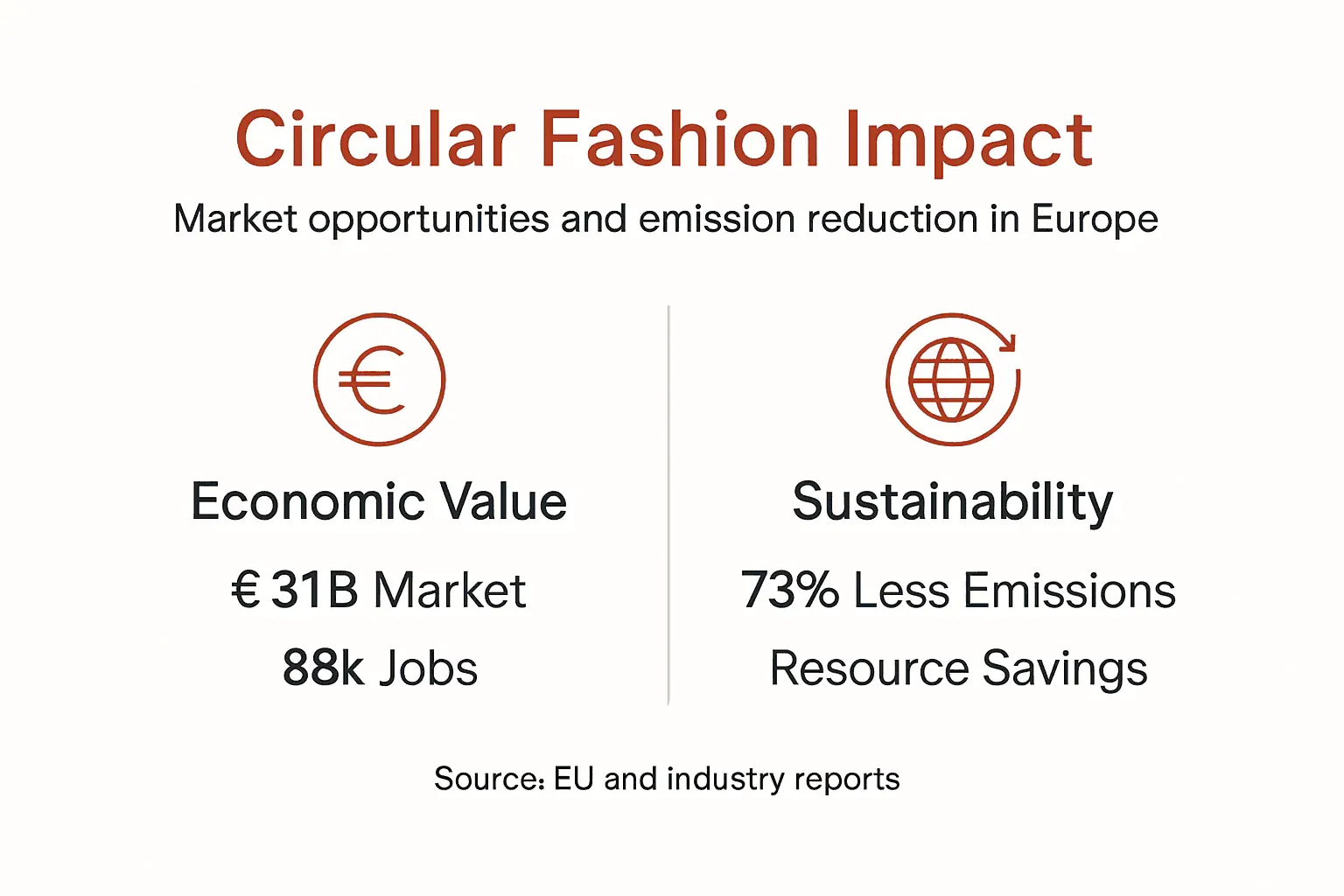
Europe’s circular fashion market will generate €31.3 billion and 88,500 jobs by 2030, transforming how brands build value. This isn’t about sustainability theatre. Circular strategies directly increase customer lifetime value through resale, repair, and recovery while meeting strict EU mandates.
This article explores the economic drivers, regulatory requirements, technology enablers like AI, and practical steps European fashion executives need to implement circular models that deliver measurable commercial returns alongside environmental impact.
Europe’s circular fashion sector projects €31.3B revenue and 88,500 jobs by 2030, making circularity a growth engine.Environmental impactBuying used extends garment life 2.2 years, cutting footprint up to 73%; repair reduces CO2 by 30%.Regulatory pressure EU mandates separate textile waste collection and Extended Producer Responsibility by 2025, forcing brand accountability.
Technology enablers AI and Digital Product Passports track lifecycle data, predict product value, and optimize recovery routing for maximum returns. Business benefits Circular programs reactivate customers, increase average order value, and reduce acquisition costs through loyalty.
Circular fashion replaces the linear produce, consume, discard model with one designed to keep products in use. Where traditional fashion extracts raw materials, manufactures garments, sells them, and eventually sends them to landfill, circular systems design for longevity, enable repair and resale, and recover materials for new production.
The urgency is clear. The global fashion industry generates 92 million tons of textile waste annually, most ending in incinerators or dumps. European regulators responded with deadlines that arrived this decade. The EU mandates separate collection of textile waste by 2025, holding brands accountable for product end of life.
Circular fashion rests on four interconnected pillars:
European fashion brands face a strategic choice. They can view these shifts as compliance burdens or explore circular strategies that unlock new revenue streams and deepen customer relationships. The principles of circular fashion offer frameworks that turn regulatory pressure into competitive advantage.
For executives, the question isn’t whether to adopt circular models but how quickly to integrate them into core operations before competitors capture first mover benefits.
The business case for circularity combines compelling economics with regulatory inevitability. Europe’s circular fashion market represents a €31.3 billion opportunity creating 88,500 jobs by 2030. These aren’t projections for distant futures. Brands implementing circular fashion programs today capture early market share in resale, repair services, and material recovery.
Regulatory drivers accelerate this shift. The EU’s separate collection rules and Extended Producer Responsibility mandates require brands to manage product lifecycles beyond point of sale. EPR schemes make producers financially responsible for collection, sorting, and recycling of textiles. Separate collection requirements mean consumers can no longer discard clothing in general waste streams.
These regulations carry financial implications:
Yet compliance creates opportunities. The EU offers financial incentives for eco design investments and recycling infrastructure development. Early movers secure favorable terms and build expertise competitors must later acquire at higher cost.
Circularity also manages risk. Supply chain disruptions exposed fashion’s vulnerability to virgin material availability. Recovered textiles provide alternative feedstocks, reducing dependence on volatile commodity markets. Customer expectations shift rapidly. Brands that lag circular adoption face reputational damage and lost market share to competitors meeting sustainability demands.
Pro Tip: Treat regulatory compliance as a strategic investment rather than cost center. Building circular capabilities now positions your brand to capture growing customer demand while competitors scramble to meet minimum standards.
The business benefits of circular economy models extend beyond compliance to genuine competitive advantage through innovation and customer loyalty.
Circular initiatives directly impact customer economics. Resale and repair programs don’t just reduce environmental footprint. They transform one time transactions into ongoing relationships that increase purchase frequency and average order value.

Resale extends product utility dramatically. Buying a used garment extends its life by 2.2 years and reduces footprint up to 73% compared to buying new then discarding. For brands, this creates multiple revenue opportunities from a single product. The initial sale generates margin. The trade in or resale transaction captures additional value. The customer who purchases the used item enters your ecosystem.
Repair services deliver similar benefits with different mechanics. Repair cuts CO2 emissions 30% and extends lifespan 70%, increasing customer satisfaction. Customers who repair items demonstrate higher brand attachment than those who simply replace. They invest time and money maintaining products, signaling commitment.
Brands implementing resale initiatives reactivate customers and increase average order value. Trade in programs bring lapsed customers back into purchase cycles. Store credit for returned items often exceeds the credit value in final transaction size. Customers trading in feel good about sustainability while justifying new purchases.
The economics work because circular programs reduce customer acquisition costs. It costs significantly less to reactivate an existing customer through trade in offers than acquire new customers through paid marketing. Resale and repair programs also generate first party data about product performance, customer preferences, and inventory needs that inform design and merchandising decisions.
The resale market growth and brand initiatives demonstrate that secondary markets complement rather than cannibalize primary sales. Customers engaged in circular programs often increase total spending with brands as they perceive greater value and alignment with personal values.
Recycling represents the circular economy’s final frontier, yet current performance reveals systemic gaps. Only 1% of textile materials are recycled into new clothing globally. The remaining 99% becomes downcycled products like insulation, gets incinerated, or ends in landfill.
Fiber complexity creates the primary technical barrier. Fashion products blend natural and synthetic fibers to achieve desired aesthetics and performance. Cotton polyester blends dominate mass market apparel. Separating these fibers for recycling requires sophisticated chemical or mechanical processes that remain expensive at scale. Dyes, finishes, and embellishments further complicate material recovery.
Infrastructure gaps compound technical challenges. Collection systems lack capacity and geographic coverage. Sorting facilities can’t process the volume and variety of textile waste streams efficiently. Recycling plants capable of fiber to fiber transformation remain rare and regionally concentrated.
Yet these challenges define opportunities for strategic brands:
Recycling delivers strategic value beyond environmental credentials. Recovered materials reduce virgin feedstock costs and supply chain risk. Brands with recycling capabilities can market closed loop products commanding premium prices. Material recovery data informs design teams about durability and wear patterns.
Pro Tip: Don’t wait for perfect recycling solutions. Start building collection and sorting capabilities now with partners while investing in fiber separation technology development. Early infrastructure investments compound as regulations tighten and material costs rise.
The path forward requires collaboration. No single brand can build complete recycling infrastructure. Industry consortiums, technology partnerships, and policy engagement create the ecosystem needed to make overcoming recycling challenges commercially viable.
Circular business models generate complexity. Tracking thousands of products through multiple use cycles, predicting residual values, and routing items to optimal recovery channels overwhelms manual processes. Technology provides the answer.
Digital Product Passports create unique digital identities for physical products. These passports store material composition, manufacturing details, repair history, and usage data. As products move through their lifecycle, passports accumulate information that enables informed circular decisions. When a customer returns an item, the passport reveals whether it’s suitable for resale, needs repair, or should enter recycling.
AI algorithms transform passport data into actionable intelligence. Digital Product Passports and AI enable lifecycle visibility, product recognition, and value prediction. Machine learning models analyze condition, market demand, and brand data to forecast residual value with increasing accuracy. This determines optimal pricing for resale items and identifies repair candidates with highest return potential.
The benefits compound quickly:
Implementing AI enabled circular systems requires foundational capabilities. Brands need data infrastructure connecting point of sale systems, customer relationship management platforms, and supply chain operations. Product identification through tags, QR codes, or image recognition links physical items to digital passports. Integration with existing technology stacks ensures circular data flows into business intelligence and decision making.
Steps for effective adoption include:
AI driven circular platforms handle this complexity, providing brands with turnkey solutions that connect new sales and existing customer wardrobes to measurable circular actions. The technology exists. The question is implementation speed and integration quality.
Misconceptions about circular fashion slow adoption among brands positioned to benefit most. Let’s address the myths with data.
Myth one: Circular models primarily generate costs. Reality shows circular economy initiatives drive new revenue streams, improve loyalty and reduce acquisition costs. Resale platforms create incremental margin. Repair services command fees. Material recovery reduces input costs. Customer lifetime value increases through ongoing engagement.
Myth two: Circularity remains a niche trend for sustainability focused consumers. Market data contradicts this. Resale is expected to grow 11 times faster than traditional retail, with 42% of Gen Z shopping secondhand. Mainstream consumers now expect circular options. Brands without them lose market share.
Myth three: Recycling solves the textile waste problem if brands invest sufficiently. We’ve seen only 1% of materials get recycled into new clothing. Recycling plays a role but can’t substitute for design improvements, use extension, and demand reduction. Circular strategies require all four pillars working together.
Myth four: Regulations drive circular adoption more than consumer demand. Both matter equally. Compliance creates baseline requirements, but competitive advantage comes from exceeding minimums to meet customer expectations. Leading brands view eco friendly fashion as market positioning, not just regulatory checkbox.
Key misconceptions to discard:
An industry expert captured the commercial reality: “Circular business models aren’t charity. They’re strategic investments that reduce risk, increase customer value, and create competitive moats through data and relationships competitors can’t easily replicate.”
The business benefits of circular economy models become clear when brands move past misconceptions to implementation. Early adopters already measure returns. Laggards face the cost of delayed action.
Translating circular principles into operational reality requires structured approaches and learning from successful implementations. Here’s your roadmap.
European brands demonstrate these principles in action. Several have integrated resale into core e commerce platforms, making secondhand purchasing seamless alongside new items. Others partner with repair marketplaces, training independent craftspeople to service their products while maintaining quality standards. Resale, repair, and recycling programs produce measurable increases in LTV and brand value when implemented strategically.
Success factors include executive sponsorship, cross functional integration, and technology enablement. Circular initiatives fail when treated as sustainability department side projects. They succeed when embedded in merchandising, operations, and customer experience with C suite accountability.
Scalability comes through partnerships and platforms. Few brands can build complete circular infrastructure independently. Technology providers, logistics partners, and material processors offer specialized capabilities. Leading circular initiatives require ecosystem orchestration more than isolated capability building.
Pro Tip: Start with pilot programs measuring customer response and unit economics, then scale proven models across categories and geographies. Avoid the paralysis of seeking perfect solutions before launch.
The brands winning circular economy transitions share common traits. They move quickly, iterate based on data, and view circularity as strategic transformation rather than incremental program addition.
Implementing the circular strategies outlined requires technology infrastructure connecting products, customers, and recovery channels. Reclaim platform for resale and customer engagement provides the AI intelligence enabling fashion brands to build circularity into every sale and recover products with measurable commercial value.
Our infrastructure connects new sales and existing customer wardrobes to clear circular actions you can measure and monetize. Reclaim’s AI powered circular tools offer product recognition, future value prediction, wardrobe connectivity, and smart routing into resale, donation, or recycling. This transforms circularity from an additional program into a driver of customer lifetime value, predictable recovery flows, and lower acquisition costs.
European fashion executives ready to capture the €31.3 billion circular market opportunity can join the circular fashion movement with Reclaim to turn regulatory requirements and customer expectations into sustainable competitive advantage.
Circular models generate multiple revenue streams from single products through resale, repair services, and material recovery. They increase customer lifetime value by reactivating lapsed buyers and deepening brand attachment through ongoing engagement. Brands also reduce acquisition costs and gain competitive advantage as consumer demand for sustainable options accelerates.
The EU mandates separate collection of textile waste and Extended Producer Responsibility by 2025, making brands legally accountable for product end of life. These requirements force investment in take back infrastructure, material tracking, and recovery systems. However, compliance creates opportunities to capture value from returned products while meeting growing customer expectations for brand responsibility.
AI algorithms analyze product data to predict residual value, optimize recovery routing, and personalize customer engagement based on ownership patterns. Digital Product Passports powered by AI track lifecycle information enabling informed circular decisions. This technology transforms manual, inefficient processes into scalable systems that maximize recovery value and customer lifetime value simultaneously.
Trade in programs reactivate dormant customers and drive higher average order values through store credit incentives. Repair services build brand attachment and demonstrate product quality, increasing repurchase intent. Both models generate first party data about preferences and product performance that inform merchandising and design decisions, creating compounding advantages.
Only 1% of textiles get recycled into new clothing due to fiber complexity, inadequate sorting infrastructure, and limited processing capacity. Blended materials resist separation, and chemical recycling technologies remain expensive at scale. However, these gaps represent opportunities for brands investing in recycling partnerships, designing for recyclability, and building material recovery capabilities ahead of regulatory and competitive pressure.
